
Oklahoma City Pedestrian Accident Lawyers

Someone has probably already told you it was your fault for being on the road. It may have been the driver, an officer at the scene, or an adjuster on the phone three days later.

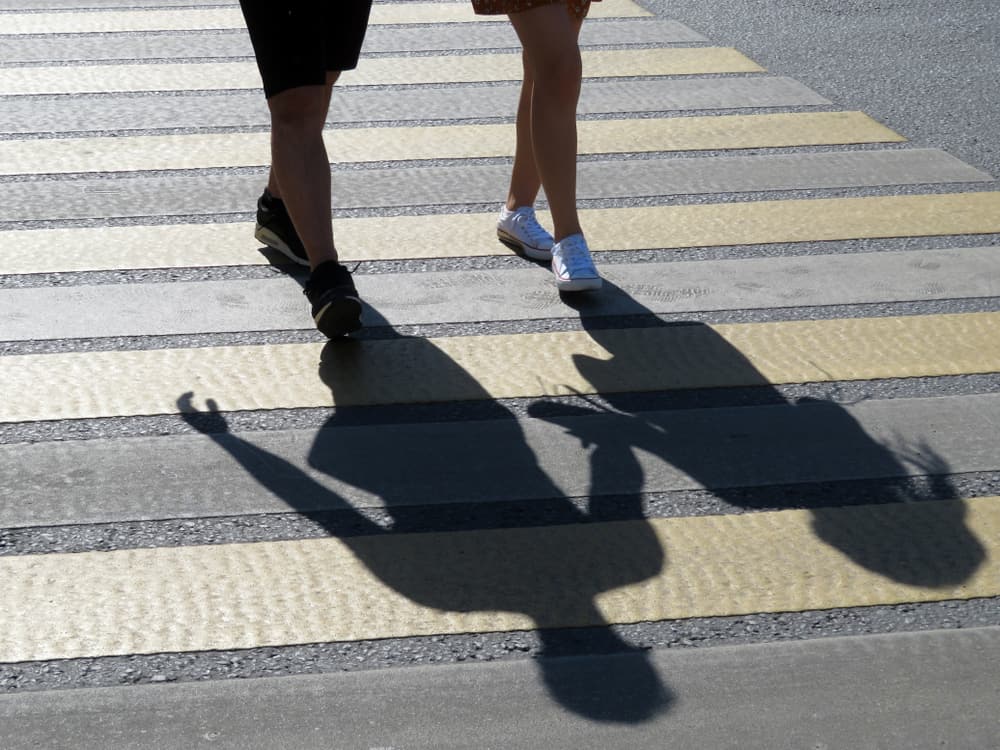
Before you accept that, here is a piece of Oklahoma law almost nobody knows. A legal crosswalk exists at an intersection with sidewalks on both sides whether or not anyone painted lines on the pavement. Our Oklahoma City pedestrian accident lawyers use that statute constantly, because the assumption that “no paint means no crosswalk” is wrong and it is the foundation of most of these denials.

AP Injury Lawyers is at 2248 NW 40th Street in Oklahoma City. We handle claims for people struck while walking across Oklahoma County and the surrounding metro.

Call (405) 336-3000 before you accept anyone’s version of where you were standing. No charge, and we answer at any hour.

You Were Probably in a Crosswalk Even If There Was No Paint

Oklahoma defines “crosswalk” in two parts, and the first part has nothing to do with markings. It is the part of a roadway at an intersection included within the connections of the lateral lines of the sidewalks on opposite sides of the street. In plain terms: draw the sidewalk edges straight across the road, and that space is a crosswalk by operation of law.

The second part of the definition covers what everyone pictures, which is a portion of roadway marked for crossing by lines or other markings.

So Oklahoma has two kinds of crosswalks, and only one of them is visible:

Where you were

Is it a crosswalk?

Who yields

Painted lines, anywhere

Yes, marked crosswalk

Driver yields to you

Intersection with sidewalks on both sides, no paint

Yes, unmarked crosswalk

Driver yields to you

Mid-block, away from any intersection

No

You yield to traffic, but see the next section

This is not a stretched reading. Two other Oklahoma pedestrian statutes independently use the exact phrase “unmarked crosswalk at an intersection,” which only makes sense if unmarked crosswalks exist.

Where there is a crosswalk, marked or not, and signals are not in place or not operating, the driver must yield the right of way, slowing or stopping if necessary, to a pedestrian on the driver’s half of the road or approaching closely enough from the other half to be in danger.

One more rule that decides a lot of these cases: when a vehicle is stopped at a crosswalk to let someone cross, a driver approaching from behind may not overtake and pass that stopped vehicle. That statute exists precisely because of the person who gets hit by the car in the next lane.

One honest limit. The unmarked crosswalk definition is keyed to sidewalks existing on opposite sides. At an intersection with no sidewalks at all, the argument is weaker.

What If You Crossed in the Middle of the Block?

You may still have a claim, and people talk themselves out of one here constantly. It is true that a pedestrian crossing at any point other than a crosswalk must yield to vehicles on the roadway. Crossing mid-block puts some of the fault on you.

Some fault is not all fault. Oklahoma reduces your recovery by your percentage and bars it only if your share is greater than the driver’s.

What keeps the driver’s percentage on the board is a separate Oklahoma statute that applies no matter who had the right of way:

“Notwithstanding the foregoing provisions of this chapter, every driver of a vehicle shall exercise due care to avoid colliding with any pedestrian upon any roadway and shall give warning by sounding the horn when necessary and shall exercise proper precaution upon observing any child or any confused or incapacitated person upon a roadway.”

Read the first clause again. The duty of due care exists regardless of the right of way rules that come before it. A driver who was speeding, texting, running a light, or simply not looking does not get excused because you were not in a crosswalk.

Facts that push the driver’s share up: excessive speed for conditions, distraction, impairment, a long clear sight line, no braking before impact, and poor lighting the driver should have accounted for. Federal guidance from NHTSA on pedestrian safety describes the driver behaviors behind these crashes, and it is a useful reference point for what a careful driver is expected to do.

A related rule worth knowing: between adjacent intersections where signals are operating, pedestrians must cross only in a marked crosswalk. And where sidewalks exist, walking along the adjacent roadway is unlawful. Where there is no sidewalk, walk facing traffic on the left side or shoulder.

Who Pays If the Driver Fled or Had No Insurance?

Very possibly your own auto insurance, even though you were on foot. This is the single most useful thing on this page for anyone who has been told there is no money in their case.

Oklahoma law prescribes the exact wording insurers must use on the uninsured motorist disclosure form every customer receives. That statutory language says the coverage:

“protects you and family members who live with you while riding in any vehicle or while a pedestrian.”

Uninsured motorist coverage, usually shortened to UM, follows the person rather than the car. Underinsured coverage, or UIM, is built into the same Oklahoma statute, which defines an uninsured vehicle to include one whose liability limits are less than the amount of the claim. And the statute expressly covers hit and run vehicles, which is exactly the driver who did not stop.

Three practical points:

  • You may have this coverage without remembering you bought it. Oklahoma insurers must include it unless the customer signed a written rejection.
  • The UM limit is on your declarations page, not on the card in your wallet. If you cannot find the declarations page, your agent can send it the same day.
  • The statutory form says “unless otherwise provided in your policy,” so the actual policy language governs. That is a reason to have someone read it rather than a reason to assume you are out of luck.

If you were told there is nothing to claim because the driver had no insurance, call (405) 336-3000. We will read your own policy at no cost.

What the Law Required the Driver to Do

Stop, stay, identify, and help.

Oklahoma law requires a driver in an injury accident to stop immediately at the scene, or as close to it as possible, and to remain there. Before leaving, the driver must give their name, address, and vehicle registration number, show a license and insurance verification on request, and render reasonable assistance to anyone injured, including arranging transport to a hospital where that is needed.

Leaving is a felony. Willfully failing to stop after an accident involving non-fatal injury is a felony carrying imprisonment and a fine, plus mandatory revocation of the driver’s license. Where the accident caused a death, the penalties are substantially greater.

Two things this means for your case:

  • A hit and run is not a dead end. It is a criminal investigation running alongside your claim, and the police file, nearby camera footage, and vehicle debris often identify the driver weeks later.
  • Do not wait on the criminal case to protect the civil claim. The deadlines run independently.

If the driver did stop but gave you incomplete information, that is its own statutory violation and worth documenting.

Children Are Held to a Different Standard on Oklahoma Roads

The same due care statute names them specifically. It requires every driver to exercise proper precaution upon observing any child or any confused or incapacitated person on a roadway. That is an explicit, heightened statutory duty, not an argument someone invented for litigation.

The practical consequence is that “he darted out” carries much less weight than drivers expect. A child near a roadway is exactly the circumstance the statute tells drivers to slow down for.

School zones and school buses have their own rules. Oklahoma requires drivers to stop for a school bus displaying its red loading signals and to wait until the signals go off before proceeding cautiously, with a fine and an additional special assessment for violations. The Oklahoma Highway Safety Office publishes the state’s guidance for drivers and pedestrians.

Deadlines also work differently for an injured minor under Oklahoma law, which can preserve a child’s own claim beyond the ordinary window. Do not rely on that without advice, and note that claims against government entities are not treated the same way.

How Long Do You Have, and What If a City Vehicle Was Involved?

Two years from the date you were hit, for a claim against a private driver. That is Oklahoma’s general injury deadline.

If a city bus, a municipal vehicle, or a government employee was involved, you are on a different and much shorter track. Written notice must be presented within one year of the loss, the entity then has 90 days in which silence counts as a denial, and suit must follow within 180 days of that denial.

There is a nuance about traffic signals that is worth stating precisely, because it decides whether a claim exists at all. Oklahoma’s Governmental Tort Claims Act exempts government entities from liability for the absence, condition, location, or malfunction of a traffic sign or signal unless the problem is not corrected within a reasonable time after the entity had actual or constructive notice of it. The Act also excludes liability for failing to install a sign or signal in the first place.

In plain terms: a crossing signal the City knew was broken and left broken may support a claim. A crossing signal that was never installed generally does not.

Oklahoma City Council adopted a Vision Zero plan on February 25, 2025, aimed at eliminating traffic deaths and severe injuries. That plan and the crash mapping behind it can matter to the question of what the City knew about a particular location.

Working With This Firm

This firm is led by Austin S. Pieratt, a graduate of Oklahoma City University School of Law who chose to practice in Oklahoma. Pedestrian claims are handled alongside the firm’s vehicle work, and that overlap matters: these cases get defended by auto insurers running the same comparative fault playbook they use on crashes.

Google reviews put the firm at 5.0 across several hundred ratings, and someone answers at any hour.

We handle pedestrian, bicycle, car, motorcycle, truck, and rideshare crashes, plus wrongful death. We do not take product liability, medical malpractice, or construction site cases.

Frequently Asked Questions

The police report says I was at fault. Is my case over?

No. A police report is one officer’s opinion formed quickly, often without the pedestrian’s account because that person was being taken to a hospital. It is not admissible as a finding of fault, and it is regularly revised or contradicted by scene evidence, vehicle damage, and witness statements gathered later. Get a copy, read it for factual errors like the location or the direction you were walking, and do not treat it as the last word.

It does not. A pedestrian citation is handled in municipal court and is entirely separate from your civil injury claim. It will be used to argue your share of fault, which reduces your recovery, but Oklahoma bars recovery only when your share exceeds the driver’s. Do not plead to the ticket without mentioning it to your attorney first, since how it resolves can affect the civil case.

Usually yes, though the analysis shifts. Oklahoma’s right of way statutes are written for roadways, so a parking lot collision often turns on ordinary negligence rather than a specific traffic statute, and the property owner’s maintenance and design may also come into play. Low speed does not mean minor injury, particularly for older pedestrians. These claims are worth evaluating rather than assuming away.

Nobody can answer that responsibly in a first phone call, and be wary of anyone who does. Value depends on the medical picture once treatment stabilizes, whether the injury is permanent, lost income and earning capacity, and above all how much insurance is reachable. Oklahoma has no cap on pain and suffering, so the ceiling is usually set by available coverage rather than by law.

The Word of the Person Who Hit You Is Not the Record

In most pedestrian cases the driver gives a statement while the pedestrian is in an emergency room. That version reaches the police report, the insurer, and the file, and it becomes the default account of what happened simply because it arrived first.

It can be answered. Scene measurements, sight line analysis, signal timing, business cameras, and the physical damage on the vehicle all speak, and they do not have an interest in the outcome. All of it degrades quickly.

Call or text AP Injury Lawyers at (405) 336-3000. 2248 NW 40th Street, Oklahoma City, OK 73112. Available 24 hours.

austin pieratt esq ap injury lawyers in Oklahoma City personal injury law

Austin Pieratt Esq., Founder & Managing Attorney

Call For A Free Consultation. 

Available 24 Hours A Day, 7 Days A Week.

Oklahoma City Office

2248 NW 40th Street
Oklahoma City, OK 73112

(405) 336-3000

quotation mark

Reviews From Our Clients

AP Injury Lawyers place picture
5.0
Based on 532 reviews
Mujidat Seidu profile picture
Mujidat Seidu
2 months ago
This law firm dealt with me with honesty, sincerity, & clarity. I was involved in a car wreck in the most unthinkable time of my life. I received a much needed help in a timely manner. I would recommend them to anyone that’s needing injury lawyer.

Kathy Marti profile picture
Kathy Marti
2 months ago
Austin Perat was very helpful on giving me advice on a legal issue I have right now. The law firm called me back immediately.

Abigail Sheehy profile picture
Abigail Sheehy
2 months ago
I can’t recommend AP Injury Lawyers enough! After my car accident, they were incredibly kind, compassionate, and helpful every step of the way. They took the time to answer all of my questions, kept me informed throughout the entire process, and truly made a stressful situation so much easier to navigate.

I always felt like they genuinely cared about me and my recovery, not just my case. They took great care of me from start to finish, and I never felt like I was going through everything alone. If you’ve been in a car accident and need someone you can trust to fight for you while treating you with kindness and respect, I highly recommend them.

lily rooks profile picture
lily rooks
2 months ago
Emily Mullins profile picture
Emily Mullins
2 months ago
We chose AP Injury Lawyers because of their outstanding reviews, so I wanted to share my experience for anyone else trying to make the same decision.

From start to finish, working with Austin and his team was an exceptional experience. The entire process was smooth, organized, and stress-free. They handled everything, so we never had to wonder what was happening or what came next. Communication was 10/10 — we were always kept informed and any questions we had were answered promptly.

Most importantly, the outcome exceeded our expectations. We couldn’t be happier with the level of professionalism, responsiveness, and care we received. Highly recommend AP Injury Lawyers to anyone looking for a team that truly delivers.

David Strickland profile picture
David Strickland
3 months ago
Austin, himself, called me Saturday afternoon by way of a referral that he received from an out of state law firm whose ad I had responded to. I had previous semi-favorable experience with a law firm in a similar situation, and I wanted a wholly favorable experience this round, so I had spoken with numerous law firms who all straight away sent to me their contract wanting my signature. I refused to sign any because I wasn’t comfortable with their pitch for one reason or another. Austin was different.

Austin earned my trust and my case lending me a glimpse of insight to the culture he had created for his law firm. I signed that day, and eight days later he called me to say that the insurance company had agreed to pay policy max. I’m happy with Austin and his crew for doing what I alone had failed to do: bring timely acceptable closure to a tinder issue. I highly recommend APInjury Lawyers, because Austin is at the helm, and I trust him.
Humbly, David Strickland
Aurora Martinez profile picture
Aurora Martinez
3 months ago
Tripp Walcher was incredibly helpful with my case. From the beginning, communication and care was excellent. Once he took over my case, I didn’t really have to worry about it. He helped explain the complex parts and laws related to my accident in simple terms and provided timely updates. He acted in my best interest and I was relieved to have him in my corner. I highly recommend his services to others.
Matty M profile picture
Matty M
3 months ago
Start to finish Austin worked incredibly hard and fast to get the maximum results for my settlement. Incredible professionalism and top tier communication and service. If you or someone you know is looking for a personal injury lawyer, 10/10 recommend Austin and his team!

Rachel Meyer profile picture
Rachel Meyer
4 months ago
I highly recommend AP Injury Lawyers. From the second I called, they were professional, responsive, and incredibly helpful.
Also, a great outcome! I worked directly with Tripp, who was kind, supportive, and knowledgeable throughout the entire process. He consistently checked in with me, explained everything clearly, and made sure I understood each step along the way.

I had never been in a situation like this before, and they truly made the process feel easy and stress-free. They handled everything and helped bring me peace of mind during a difficult time. I’m so grateful for their help and would absolutely recommend them to anyone needing an injury attorney.

Hotladypimpin profile picture
Hotladypimpin
11 months ago
Nice place. Easy process. Good outcome to say the least. I’m just glad it’s over. They did an outstanding job and went for the big prize! I’m proud of them for that! Bless their hearts for the work they do. We can’t win without em. Thanks guys God bless you both Austin and Tripp