
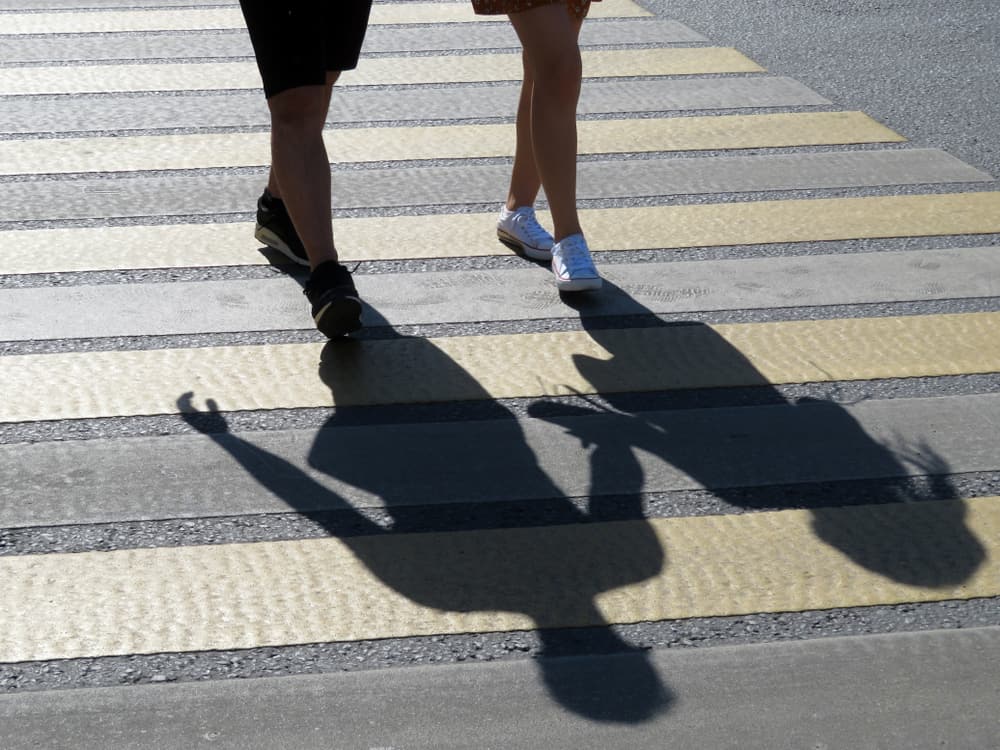
Pedestrian right-of-way laws in Oklahoma City come from state statute, and they are more specific than most people on either side of the windshield realize. The rules turn on a single definition that almost nobody has read.
Most drivers believe a crosswalk is something painted on the road. Oklahoma law says otherwise, and that difference decides a large share of pedestrian claims in the metro.
Key Takeaways About Oklahoma Pedestrian Rules
- Oklahoma defines a crosswalk to include the unmarked connection between sidewalks at an intersection, so paint is not required.
- Drivers owe a duty of due care to every person on a roadway, crosswalk or not, and must sound a horn when necessary.
- A person on foot may not suddenly step off a curb into the path of a vehicle too close to stop.
- Crossing mid-block is prohibited only between adjacent intersections where signals are operating.
- Most pedestrian deaths nationally happen after dark and away from intersections, which insurers often misread as automatic pedestrian fault.
Key Statistics About Pedestrian Crashes
Federal data shows where and when these crashes actually happen, and the pattern complicates the usual fault assumptions.
- The National Highway Traffic Safety Administration counted 7,314 pedestrian deaths in 2023 and an estimated 68,244 injuries, a fatality rate of 2.18 per 100,000 people.
- 77% of those deaths occurred in dark conditions and 74% happened at non-intersection locations, per the same federal report. Both figures get cited against pedestrians, though neither establishes who failed to yield.
- Oklahoma recorded 87 pedestrian deaths in 2023, representing 12.1% of all traffic fatalities in the state, per NHTSA state data.
Who Has to Yield When a Person Crosses a Street in Oklahoma?
It depends on where the crossing happens. Drivers yield to anyone in a crosswalk when no signal is operating, and a legal crosswalk exists at every intersection where sidewalks meet the street, painted or not. Outside a crosswalk, the person on foot yields. No driver may pass a vehicle stopped at a crosswalk. Right of way and freedom from fault are different questions.
What Counts as a Crosswalk Under Oklahoma Law?
Two things, and the first one surprises nearly everyone. Title 47, Section 1-111 defines a crosswalk as:
“(a) That part of a roadway at an intersection included within the connections of the lateral lines of the sidewalks on opposite sides of the highway measured from the curbs or, in the absence of curbs, from the edges of the traversable roadway; (b) Any portion of a roadway at an intersection or elsewhere distinctly indicated for pedestrian crossing by lines or other markings on the surface.”
Subsection (a) is the unmarked crosswalk. Wherever sidewalks on opposite sides of a street meet at an intersection, the space between them is legally a crosswalk whether or not anyone painted it.
That single definition changes the analysis in a large share of Oklahoma City cases. A person struck while crossing at a residential intersection with no markings was, in the eyes of the statute, in a crosswalk.
Section 11-502(d) reinforces the point, referring expressly to “any unmarked crosswalk at an intersection.”
Who Must Yield, and Where?
The answer changes with the location, and Oklahoma sets it out situation by situation.
Situation | Who yields | Statute |
Marked crosswalk, no signal operating | Driver yields to the person crossing | 47 O.S. § 11-502(a) |
Unmarked crosswalk at an intersection, no signal | Driver yields | 47 O.S. §§ 1-111, 11-502(a) |
Person suddenly steps off a curb into close traffic | Person on foot is at fault | 47 O.S. § 11-502(b) |
A vehicle ahead is stopped at a crosswalk | No passing that vehicle | 47 O.S. § 11-502(d) |
Crossing anywhere other than a crosswalk | Person on foot yields to vehicles | 47 O.S. § 11-503(a) |
A pedestrian tunnel or overpass is available | Person on foot yields | 47 O.S. § 11-503(b) |
Between two adjacent intersections with signals | Crossing outside a marked crosswalk is prohibited | 47 O.S. § 11-503(c) |
Walking along a road with no sidewalk | Walk on the left, facing traffic, and yield | 47 O.S. § 11-506(b) |
Approaching a person with a white cane or service dog | Driver must come to a full stop | 7 O.S. § 12 |
What Does Oklahoma Law Require of Drivers?
More than yielding at marked crossings, and the additional duties are where cases are often decided.
When must a driver yield to someone in a crosswalk?
When no traffic control signal is in place or operating, and the person is either on the driver’s half of the roadway or approaching closely enough from the other half to be in danger. Section 11-502(a) requires the driver to yield, “slowing down or stopping if need be to so yield.”
The statute frames this as an active obligation. A driver who maintains speed and expects a person to wait has not complied.
Can you pass a car stopped at a crosswalk?
No, and this rule causes crashes precisely because so few drivers know it. Section 11-502(d) provides that when any vehicle is stopped at a marked or unmarked crosswalk to let a person cross, “the driver of any other vehicle approaching from the rear shall not overtake and pass such stopped vehicle.”
The reason is visibility. The stopped vehicle hides the person crossing from everyone behind it, and multi-lane arterials across Oklahoma City produce this exact geometry every day.
What does a driver owe outside a crosswalk?
Ordinary care, regardless of the rules of way. Section 11-504 requires that “every driver of a vehicle shall exercise due care to avoid colliding with any pedestrian upon any roadway,” shall “give warning by sounding the horn when necessary,” and shall “exercise proper precaution upon observing any child or any confused or incapacitated person upon a roadway.”
That last clause matters. A driver who sees a child near the roadway owes heightened caution even where the child has no right of way at all.
What Does the Law Require of People on Foot?
Rules that are narrower than most people assume, particularly on the question of crossing mid-block.
When must a person on foot yield?
Whenever crossing at any point other than a marked crosswalk or an unmarked crosswalk at an intersection. Section 11-503(a) requires yielding “to all vehicles upon the roadway.”
The same section requires yielding where a pedestrian tunnel or overhead crossing has been provided.
Is it illegal to cross mid-block in Oklahoma?
Only in a specific circumstance. Section 11-503(c) provides that “between adjacent intersections at which traffic-control signals are in operation pedestrians shall not cross at any place except in a marked crosswalk.”
Outside that situation, crossing mid-block is not prohibited by state statute. It requires yielding to traffic, which is a different rule with different consequences. Oklahoma City also has local traffic ordinances in Chapter 32 of its Municipal Code, so a specific location may carry additional requirements.
Guidance written for other states circulates here and causes confusion on one point in particular. Oklahoma’s statute contains no provision prohibiting crossing a street diagonally.
Where do you walk when there is no sidewalk?
On the left, facing oncoming traffic. Section 11-506(b) directs a person walking along a highway without sidewalks to “walk only on the left side of the roadway or its shoulder facing traffic which may approach from the opposite direction,” and to yield to approaching vehicles.
Where sidewalks do exist, subsection (a) makes it unlawful to walk along the adjacent roadway instead.
What Rule Applies Near Someone Using a White Cane or Service Dog?
A full stop, and the rule sits outside the traffic code entirely. Title 7, Section 12 covers drivers who knowingly approach within fifteen feet of a person in the roadway or at an intersection who is wholly or partially blind and carrying a white cane, or who is using a guide dog, signal dog, or service dog.
That driver must “immediately come to a full stop and take such precautions before proceeding as may be necessary to avoid accident or injury.” This is stricter than yielding. It requires stopping.
Does Having the Right of Way Decide Fault?
Not by itself, and this is the most common misunderstanding on both sides.
Oklahoma recognizes negligence per se, where violating a statute establishes negligence when the injury is the type the statute meant to prevent and the injured person is in the class it meant to protect. Bright-line rules like the yield requirements and the no-passing rule are the kind of provisions that fit that framework.
Broader duties may work differently. Oklahoma courts have treated statutes phrased in subjective terms, requiring care or prudence rather than a fixed standard, as restating ordinary negligence rather than supporting negligence per se. No published Oklahoma decision has applied that reasoning to Section 11-504, so how a court would treat its “due care” language is unsettled.
Practically, a driver can have the right of way and still be at fault for failing to react to something plainly visible. A person on foot can be crossing outside a crosswalk and still recover, reduced by their share of responsibility.
When Should Someone Talk to a Lawyer After a Pedestrian Crash?
Early, because the location analysis is technical and gets decided badly without it.
Whether a crossing point was legally a crosswalk depends on sidewalk geometry that a police report rarely records, and that a repaving project can erase. Photographs of curb lines and sidewalk approaches are worth taking within days.
Beyond that, the pattern worth watching for is an insurer that leads with where you were walking rather than what the driver did. That framing tends to arrive early and stick.
What Helps After a Pedestrian Collision?
The geometry, first. Photographs showing where the sidewalks meet the street on both sides establish whether an unmarked crosswalk existed, and no police report captures it. Repaving and curb work can erase the evidence within a season.
The light, second. Returning at the same hour on a later night and photographing what a driver would actually have seen carries real weight, given how many of these collisions happen after dark. Burned-out streetlights are worth reporting as well as recording.
The people, third. Anyone waiting at the same corner is often the only neutral account available, and they scatter within minutes.
Oklahoma Pedestrian Right-of-Way Questions Answered by Attorneys
Who is responsible when a crosswalk signal is broken or missing?
The rules shift when a signal is not operating, because Section 11-502(a) applies specifically to situations where signals are absent or out of service. Responsibility for the signal itself is a separate question that usually runs against a public entity, and those claims start on a much tighter schedule.
The driver said the sun was in their eyes. Does that excuse it?
Glare is a condition drivers are expected to account for, not a defense to failing to see someone. Section 11-504 requires due care regardless of conditions, and reduced visibility generally calls for more caution rather than less.
Can a person on foot be cited and still recover?
Yes. Oklahoma reduces a recovery by a person’s share of fault instead of eliminating it, unless that share exceeds the other side’s.
Does a driver who was under the speed limit have a defense?
Not on its own. Speed limits set a maximum rather than a safe speed for the conditions, and a driver approaching a school zone, a crowded corner, or a poorly lit block may be required to go slower than the posted number.
Does a parking lot count for these rules?
Private lots are generally not “roadways” under the traffic code, so the statutory yield rules may not apply directly. Ordinary negligence principles still do, and property owners can carry their own responsibilities for lot design and lighting.
Call For A Free Consultation.
Available 24 Hours A Day, 7 Days A Week.
Right of Way Is Not the Same as Being Right
Both drivers and people on foot tend to treat right of way as a verdict. It is closer to a starting point, and Oklahoma’s rules assign it differently depending on paint that may or may not exist and geometry nobody photographed.
Sorting out which rule applied at a specific corner is usually quick, and it changes the shape of everything that follows.
AP Injury Lawyers is located at 2248 NW 40th Street in Oklahoma City and serves clients in Oklahoma City, Norman, Moore, and Edmond. Call (405) 336-3000 at any hour, or reach us through our contact page. Consultations are free, and there is no fee unless there is a recovery.
