
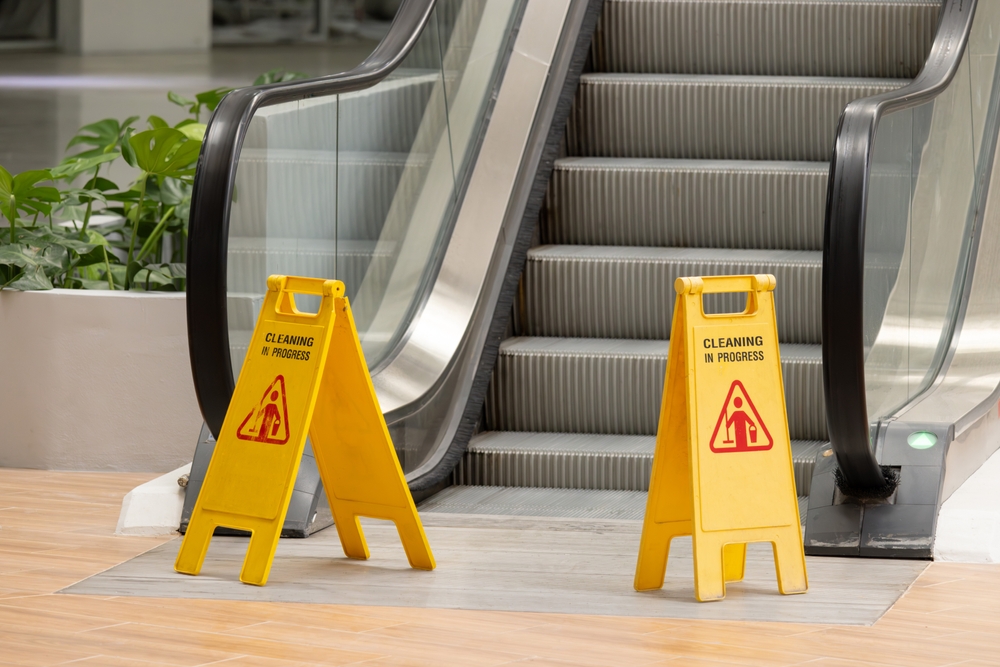
Dangerous property conditions in Oklahoma City rarely announce themselves. A puddle near a drink station, a lot that pooled and refroze overnight, a stair tread worn smooth by twenty years of traffic. None of it looks like a legal problem until someone hits the ground.
Oklahoma law asks a narrower question than most people expect. Not whether you fell, and not even whether the hazard was dangerous, but what the property owner knew and whether the hazard was theirs to begin with.
Which Hazards on a Property Can Support an Injury Claim in Oklahoma?
A condition supports a claim when the property owner created it, knew about it, or should have found it in time to fix it.
- Wet floors and spills left long enough that reasonable inspection would have caught them
- Broken or uneven surfaces including cracked lots, loose handrails, and worn stair treads
- Poor lighting in stairwells, garages, and back entrances
- Owner-created ice, such as water from sprinklers or downspouts freezing on a walkway
- Obstructed walkways including cords, stocking carts, and merchandise left in aisles
Oklahoma also has real defenses in this area, so whether a specific hazard supports a claim usually turns on details worth reviewing with a lawyer.
Key Takeaways About Slip and Fall Claims in Oklahoma City
- The injured person carries the burden of showing the owner created the hazard, knew about it, or should have known because it sat there long enough.
- Oklahoma recognizes an open and obvious defense, and it defeats a surprising number of claims.
- Ice and snow in their natural state generally do not create liability, but ice a property owner caused or worsened can.
- Your reason for being on the property changes the duty owed to you, with paying customers receiving the highest level of care.
- Incident reports written by store staff are prepared with the store’s interests in mind, and they are not neutral records.
Key Statistics About Fall Injuries
Falls are a large and growing injury category nationally. Most happen at home rather than on commercial property, which makes the scale of the medical consequences the useful part of the data here.
- Falls among older adults cause roughly 41,000 deaths each year at a medical cost near $80 billion, according to the Centers for Disease Control and Prevention, as of its September 2024 summary.
- The fall death rate among older adults climbed from 64.7 per 100,000 in 2018 to 78.4 in 2024, a 21% increase, per CDC data.
- Falls send about 1 million older adults to the hospital annually, including roughly 319,000 hip fracture admissions, according to the CDC. A hip fracture often marks a permanent change in independence, which is why these claims involve more than a hospital bill.
Which Property Conditions Most Often Lead to Falls?
Certain hazards recur across Oklahoma City properties, and each raises a different legal question.
| Condition | Where it commonly turns up | What makes it a claim |
|---|---|---|
| Standing water or spills | Grocery aisles, entryways during storm season, restrooms | How long it sat before anyone addressed it |
| Owner-created ice | Lots and walkways fed by irrigation, downspouts, or plowed piles that refroze | Whether the water source belonged to the property |
| Cracked or heaved pavement | Parking lots after freeze and thaw cycles, older strip centers | Whether the damage was reported or visible for months |
| Worn or uneven stairs | Apartment complexes, older office buildings, back exits | Missing handrails, inconsistent riser heights, no lighting |
| Inadequate lighting | Parking garages, stairwells, rear entrances after dark | Burned-out fixtures that went unreplaced |
| Tracked-in debris | Entryways during rain, gravel and red dirt near construction | Whether mats and inspection routines were in place |
| Obstructed aisles | Stocking carts, cords, pallets left during business hours | Whether the obstruction served a purpose or was simply left |
What Must You Prove About What the Owner Knew?
That the owner had notice of the hazard in time to do something about it. The Oklahoma Supreme Court put it directly in Rogers v. Hennessee, 1979 OK 138: an owner “cannot be held responsible unless it be shown that he/she had notice or could be charged with gaining knowledge of the condition in time sufficient to effect its removal or to give warning of its presence.”
Three routes satisfy that requirement. The owner created the condition, the owner actually knew about it, or the owner should have known.
What is constructive notice?
Knowledge the law assigns to an owner who was not paying attention. If a spill sat on a floor for forty minutes in a store that inspects hourly, a jury can find the owner should have discovered it.
Duration is the whole argument. A puddle that appeared thirty seconds before someone stepped in it generally will not support a claim, no matter how dangerous.
Timestamps decide it. Security footage, delivery logs, and staffing schedules are often the only proof of how long a hazard sat there.
What if the business created the hazard itself?
Then the notice question largely falls away. Oklahoma courts have recognized that when a business creates a foreseeable risk through its own methods, the injured person does not need to prove the business was separately warned about the specific condition.
Lingerfelt v. Winn-Dixie Texas, Inc., 1982 OK 44, is the Oklahoma example. A grocery store displayed strawberries in uncovered containers heaped above the rim after its wrapping machine broke. The store built the hazard, so the store owned it.
Why Is “It Was Obvious” a Real Defense Here?
Because Oklahoma has applied the open and obvious doctrine seriously for decades. A property owner owes an invitee a duty to protect against “conditions which are in the nature of hidden dangers, traps, snares and the like,” as Scott v. Archon Group, L.P., 2008 OK 45, puts it, but not against conditions a person would reasonably be expected to notice.
In that case, a driver took an eleven-foot truck into a garage with a clearly marked 8’6″ clearance beam and was left quadriplegic when the beam fell. The Oklahoma Supreme Court affirmed judgment for the property owners. The hazard was posted, visible, and legally open and obvious.
Defense lawyers reach for this argument early, and Scott shows it can bar recovery even where the injury is catastrophic.
When can a property owner not rely on that defense?
When the owner created or worsened the hazard. That distinction produced one of the more instructive Oklahoma cases, and it happened in Oklahoma City.
In Wood v. Mercedes-Benz of Oklahoma City, 2014 OK 68, a caterer’s employee arrived to work an event at the dealership and fell on ice that had spread across the grassy incline outside the entrance. No precipitation had fallen, and the public roads were clear. The ice came from the dealership’s own sprinkler system running in freezing temperatures.
The Court held the dealership owed a duty despite the visibility of the ice, noting that it has “rejected the open and obvious doctrine for a hazardous accumulation of ice, caused or enhanced by a landowner.”
Two cautions belong with that. The decision split the Court five to four, and the opinion itself limited the holding to “the peculiar facts of this case.” Scott v. Archon remains a good law.
How Does Oklahoma Treat Ice, Snow, and Weather?
Under a natural accumulation rule, which favors property owners. Weather is a shared condition, and Oklahoma expects people to account for it.
Dover v. W.H. Braum, Inc., 2005 OK 22, illustrates it, and it also happened in Oklahoma City. A customer entered a Braum’s on a dry day with an ice storm forecast and saw the de-icer already put down.
She shopped for about twenty minutes and fell on black ice that formed on the steps while she was inside. The Court affirmed judgment for the store.
The opinion states that “Mere slipperiness of ice and snow in its natural state and accumulations does not give rise to liability,” and that absent an owner act “creating a greater hazard than that brought about by natural causes,” people are expected to protect themselves from the elements.
The dividing line between Dover and Wood is not how obvious the ice was. It is where the water came from.
Does It Matter Why You Were on the Property?
Considerably. Oklahoma sorts visitors into three categories, and the duty owed changes with each.
An invitee is someone on the property for the owner’s benefit, including nearly every customer. Invitees get the highest duty: reasonable care to keep the premises reasonably safe and to warn of hidden dangers.
A licensee is a social guest, or someone present with permission but not for the owner’s business. The duty narrows to disclosing dangerous defects the owner knows about and the guest is unlikely to spot.
A trespasser receives the least. Title 76, Section 80 states that a possessor of land “has no duty to make its premises safe for a trespasser,” subject to narrow exceptions for known trespassers and for children.
The child exception runs on three age tiers. Under seven, a child is conclusively treated as unable to appreciate the risk from highly dangerous artificial conditions. From seven to fourteen, that inability is presumed but the owner can rebut it. At fourteen and older, the burden shifts to the child.
When Should You Talk to a Lawyer After a Fall?
Think about the footage. Retail camera systems record on a loop measured in days, sometimes as few as seven, and nobody preserves a recording that nobody asked for. A call in week one and a call in week four are not the same case.
Beyond that, the situations that reward an early conversation are the ones where the property has already taken a position. A manager who assured you the floor was dry. An incident report you were never shown. A claims representative who phoned before you had seen a doctor.
A fall with no lasting injury and nothing in dispute generally resolves without any of this.
What Do People Often Do in the First Hours After a Fall?
Photograph the condition before anyone touches it. Staff usually clean or repair a hazard within minutes, and a photo taken at 2:14 p.m. of a spill mopped at 2:20 is often the only proof it existed. Capture whether a warning cone was there, and where.
Reporting the fall to a manager before leaving is worth doing, as is asking for a copy of whatever incident report gets written. Stores are not required to hand one over, and many decline, which is itself worth knowing.
Writing down the aisle, the entrance, or the stairwell where it happened also helps more than it sounds like it should. Properties change, and a claim filed months later can turn on being able to identify the exact spot. Our premises liability page covers how these claims are built, and our FAQ page answers more general questions.
Oklahoma City Slip and Fall Questions Answered by Attorneys
The store had a wet floor sign out. Does that end my claim?
Not automatically. A sign is evidence the store knew about the hazard, which cuts both ways, and placement matters. A cone six feet past the spill, or one left out permanently in a dry area, carries far less weight than a properly placed warning.
Can I bring a claim against my landlord for a fall in a common area?
Often yes, since landlords generally retain control over shared stairwells, walkways, lots, and lighting. The lease terms and who handled maintenance are where these cases get decided.
What if I was wearing sandals or looking at my phone?
Those facts get raised, and they reduce a recovery rather than ending it, unless your share of the fault is greater than the property owner’s. Oklahoma splits responsibility by percentage in fall claims the same way it does in vehicle cases.
Do I have a claim if I fell on a public sidewalk?
Possibly, though a public sidewalk usually means a claim against a municipality, and those start with a written notice requirement measured in months. Confirming who owns and maintains that stretch of concrete is the first question, and it needs answering fast.
Will the store's insurance company tell me if I have a case?
It has no reason to. The adjuster works for the property, and the questions asked in an early call are frequently aimed at establishing that the hazard was obvious or that you were distracted.
The Six Minutes That Decide It

In a fall claim, the evidence that matters most usually exists only in the minutes between the fall and the moment someone mops the floor. What survives after that is memory, and memory does not photograph well.
If that window already closed, it is still worth asking what remains. Footage, delivery logs, and maintenance records sometimes outlast the hazard itself.
AP Injury Lawyers is located at 2248 NW 40th Street in Oklahoma City and serves clients in Oklahoma City, Norman, Moore, and Edmond. Call (405) 336-3000 at any hour, or reach us through our contact page. Consultations are free, and there is no fee unless there is a recovery.